Etiquetas
Asturians, Asturias, Cantabrians, Funerary stelae, León, Ponga, Roma, Romanization of Hispania, Rome, Vadinia, Vadinienses
by David Martino García
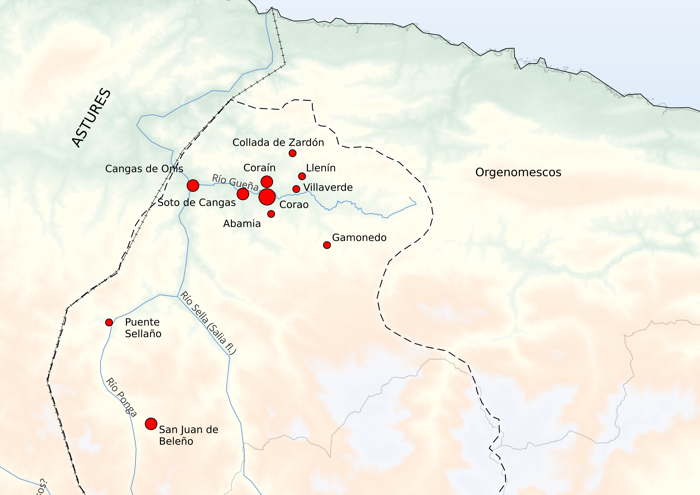
The Vadinienses were a population group from Roman Hispania who are known primarily from their tombstones. Fortunately, a fairly large set of these inscriptions has been preserved, already close to a hundred pieces, which have been located in a large, predominantly mountainous area in the east of Asturias and the northeast of the province of León. In the Asturian part, just over twenty tombstones are known, among which those from the municipality of Cangas de Onís stand out, with a greater concentration of finds in Corao, with six pieces, in Soto de Cangas, with three, and in Coraín, with two.
The Vadinienses inscriptions form a homogeneous group not only in terms of their geographical location, but also in terms of their formal characteristics and their textual and ornamental content. Indeed, they display marked originality in the supports used, in what the epitaphs say and in the various motifs used for their decoration. The preferred supports are raw stones, just as they have been collected from nature. In the decoration, the presence of the small schematic trees and the horses are notable, both very unique for their morphology and execution. Although these stelae date entirely to Roman times and are all written in Latin, the coexistence of Roman and indigenous personal names, even at later dates, is also very striking. Also significant is the mention of certain social institutions in the epitaphs.
If we look at the formal characteristics of the Vadinienses tombstones, it is clear how different they are in comparison with the funerary epigraphy of Roman cities, which follows well-established, clearly stereotyped models. The Vadinienses inscriptions are made by local artisans and, although they share characteristics, it is evident that each inscription is unique and different from the rest. It is difficult to identify possible workshops, nor is it easy to find two inscriptions made by the same hand. In contrast, the tombstones from the cities have been made by professional artisans in truly specialized workshops. Furthermore, the Vadinienses inscriptions are also quite different from other inscriptions from rural areas of northern Spain, especially in the combination of distinctive supports with ornamental elements based on horses, small trees, and other motifs. In short, the Vadiniensis epigraphy seen as a whole stands out for its uniqueness, completely distancing itself from the classic models of funerary inscriptions of Roman cities and also standing out vividly among the indigenous rural epigraphic groups.
Since these tombstones are funerary and their number is limited, the information they provide is naturally biased and partial. Biased because many questions persist regarding the social or political aspects reflected in the epitaphs; partial because there are significant gaps regarding other essential historical aspects of this people, such as their economic activities or religious practices beyond funerary beliefs. The following lines summarize what we know about the Vadinienses from their sepulchral monuments.
The civitas Vadiniensium
From literary and epigraphic sources, we know that the Vadinienses were Cantabri. Indeed, Claudius Ptolemy in his Geography indicates that Vadinia was one of the nine communities of the Cantabrians. Furthermore, in the heart of the Vadiniensis territory, the funerary stelae of Amparamus princeps Cantabrorum has been found, that is, a “prince of the Cantabrians”, this being understood to mean that Amparamo was a leading man, a distinguished man, a chief of this people.
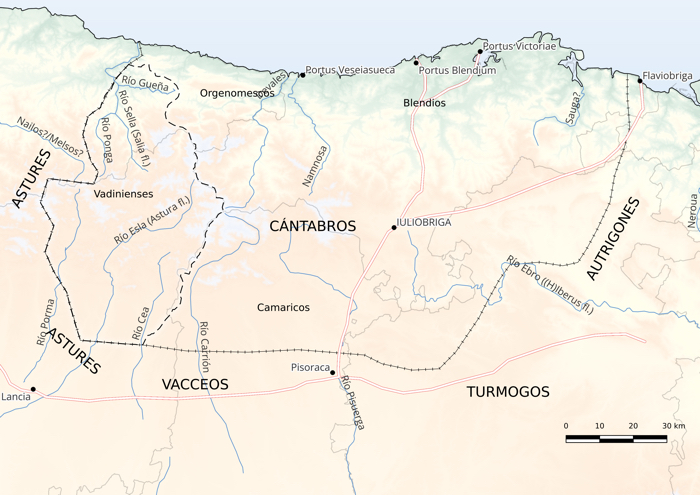
In Roman times, the Cantabri occupied a primarily mountainous territory in the central sector of the Cantabrian mountain range, between the Asón River to the east and the Sella River to the west. However, they not only occupied the northern slopes from the coast to the peaks, but also the southern slopes with the upper course of the Ebro River and the mountainous headwaters of the Esla, Carrión, and Pisuerga rivers, which flow into the Duero. Therefore, the Cantabri spread across an area that exceeds the limits of current Cantabria, occupying the east of Asturias and the northeast of León. The Vadinienses were located at the western end, bordering the Astures (map 1).
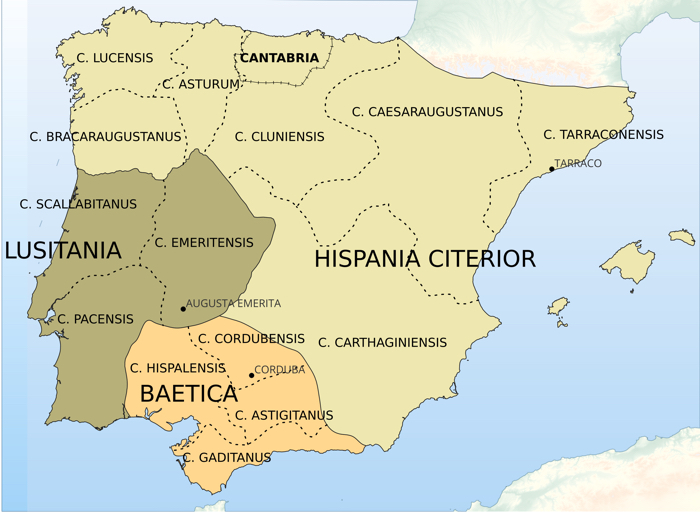
Like the rest of the Cantabrians and their Asturian neighbours, the Vadinienses were conquered during the time of Emperor Augustus, in long and difficult military campaigns that occurred between the years 29 and 19 BC. Once they had been definitively subdued and pacified, they were integrated into the province of Hispania Citerior, also known as Hispania Tarraconensis after its capital, Tarraco (Tarragona). This was a vast province that covered almost half the Iberian Peninsula and was further subdivided into seven territorial districts called conventus iuridici. The “legal convents” essentially served the functions of administering justice. The Cantabrians and other peoples from the northern Iberian Peninsula, such as the Vaccaei, the Arevaci, and the Turmogi, were part of the conventus Cluniensis, named after their capital, Clunia (Peñalba de Castro, Burgos). Lastly, in the structure of the territorial administration of the Roman Empire, below the province and the conventus iuridici there were local administration entities. Indeed, the Cantabrians, like the rest of the indigenous peoples of the conventus Cluniensis, were divided into several civitates that acted as the heads of local administration, one of which was the civitas of the Vadinienses.
As Rome expanded its Empire with the conquest of the lands surrounding the Mediterranean Sea, it undertook a veritable process of urbanization. One of the main motivations driving this process was that Rome used cities as the essential instrument for territorial organization and administration at the local level. Indeed, cities were promoted in those regions with a previous urban tradition and many others were founded where there were none, as it occurred in certain areas of Hispania where cities were scarce. However, the urbanizing drive is not contradictory to the administrative practice of the Roman Empire, marked by flexibility and pragmatism, in which the term civitas refers not only to urban communities or cities, but also to any basic entity of local administration. Thus, in regions without an urban tradition, such as Cantabria or Asturias, the civitates were rural communities with a perfectly defined territory, whose legal status was peregrine (that is, formed by free men), they had the capacity for self-government, were subject to the payment of tribute (hence the name civitates stipendiariae), and their internal territorial structure was configured by a dispersed population of small nuclei or villages. Precisely, this model of non-urban civitates adapts perfectly to a highly compartmentalized orography such as that of the Cantabrian mountains.
This type of rural civitates stipendiariae, free in the exercise of their self-government, but subject to Rome through the payment of taxes and without political independence, were very different from the ideal city model promoted by Rome, in which local administration was exercised from a true city, an urban centre that was the political-administrative centre of a given territory. To emphasize that these rural civitates with dispersed settlement and without a “city” are completely different from the classic model of the Roman city, they have been called civitates sine urbe.
It is quite common on Vadinienses tombstones for the deceased to state their status as a Vadiniensis. Thus, for example, Fuscus Cabedus Ambati f(ilius) Vadiniensis, which translates as “Fusco Cabedo, son of Ambato, from Vadinia”. This reference to his status as a Vadiniensis is comparable to the expression civis Vadiniensis, that is, “citizen of Vadinia.” From this it is understood that Fusco Cabedo was a member of this civitas peregrina, therefore, a free man from peregrine status.
Roman society was clearly hierarchical from a legal perspective. At the top were Roman citizens, who enjoyed all the rights; at an intermediate level were the Latin citizens, who had part of the rights and could access Roman citizenship based on merit; at the lowest level were the peregrine citizens, legally free, but without rights. Outside of this tripartite division were the slaves, people owned by others, who lacked any rights. But even slaves could achieve freedom by becoming freedmen. According to the epitaphs preserved in Asturias, no Roman citizen has been identified with certainty in Vadiniensis society before the 3rd century. For later dates, they are all Roman citizens, since from the year 212 an order by Emperor Caracalla eliminated the tripartite division and granted Roman citizenship to all free subjects of the Empire. We also have no evidence of slaves or freedmen, but this should not necessarily be interpreted as saying that they did not exist; perhaps their absence is due to the bias of the documentation itself, since it is natural to assume that the possibility of erecting a funerary stelae was limited to the most powerful groups of the civitas Vadiniensium.
The Vadiniensis territory
Based on the geographical distribution of the Vadinienses tombstones, as well as other historical and geographical criteria, we understand the area occupied by the civitas Vadiniensium. It is a vast, very mountainous and homogeneous territory located on both sides of the Cantabrian mountain range, measuring approximately 75 km from north to south and 50 km from east to west, and covering an area of approximately 2,300 km2. In the southern, and larger zone, the Vadinienses occupied the upper course of the Esla River with its tributaries, the Cea and Porma; and in the northern zone, they extended throughout the headwaters of the Sella River and its tributaries, the Ponga and Güeña. There was a fluid communication between both nuclei through the Ventaniella port, joining the upper Esla, through the Valdeburón valley in León, with the Ponga valley, in Asturias (map 3).
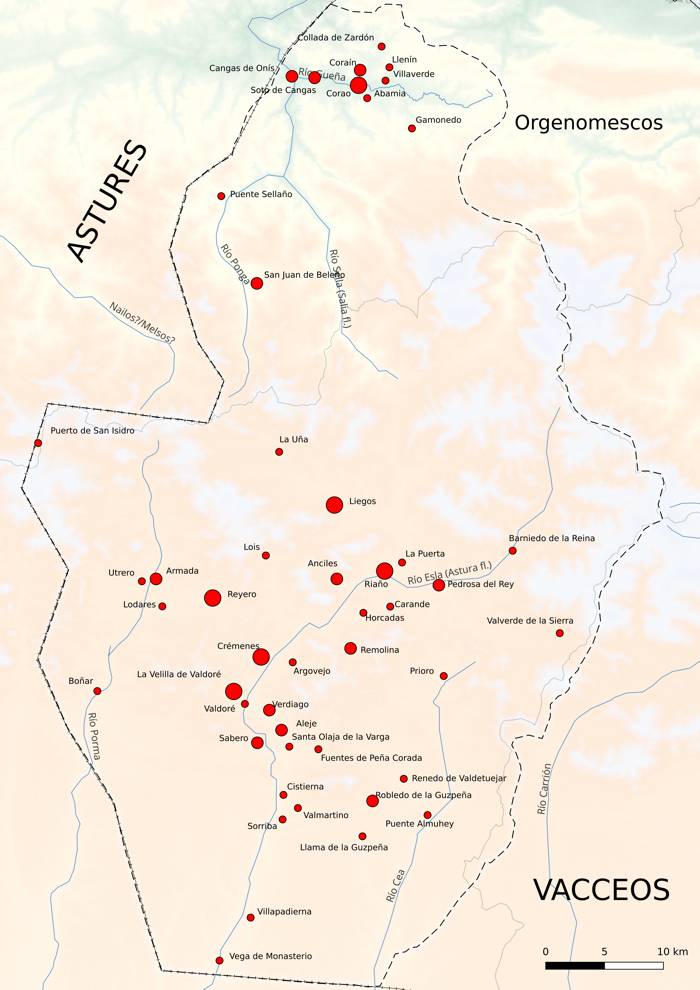
The territory of the northern Vadiniensis nucleus, that of present-day Asturias, broadly encompassed the municipalities of Ponga, Amieva, Onís, and Cangas de Onís, with a notable concentration of inscriptions in the latter municipality. In detail, the northern boundary was marked by the western foothills of the Cuera mountain range, a prominent mountain barrier running east to west that separates the Güeña River basin from the coast. This northern boundary separated the Vadinienses from the Orgenomesci, another of the Cantabrian civitates that extended along the coastal strip of eastern Asturias. The easternmost part of the region was located on the important watershed that runs between the town of La Robellada (Onís) and Alto de Ortiguero, an area where three watersheds converge: the Güeña River (Sella basin) to the west, the Casaño River (Deva basin) to the east, and the Bedón or de las Cabras River, which flows north to the Cantabrian Sea. Towards the south, this entire eastern limit was clearly marked by the formidable mountain barrier of the Picos de Europa. Finally, the western boundary was formed by the Ponga mountain range, a prominent natural divide separating the Vadinienses from the Astures, most likely from the civitas of the Luggoni. The most problematic point to specify is the northwestern border, which was probably somewhere between Cangas de Onís and Arriondas, since the lower course of the Sella River and the slopes of the Sueve mountain range belonged to the Orgenomescos. The valley of the Piloña river was also outside the Vadiniensis territory, which, despite being a tributary of the Sella, was part of the territory of the Astures. (map 4).
The Vadiniensis archaeology
One of the least known aspects about the Vadinienses are their archaeological remains, that is, the remains of their settlements, their towns, their cemeteries. We know significant information about their deceased, but where did they live? What were their homes and villages like? These are questions for which we can say very little given the almost complete absence of archaeological traces and the lack of systematic and global archaeological studies. In fact, we do not even have a satisfactory identification hypothesis for Vadinia, despite numerous attempts since the 18th century. Multiple locations have been proposed, both in eastern Asturias, for example, Corao and Benia, and in the Leonese region, among which some of the most significant hill forts stand out, such as Riaño, Pedrosa del Rey, Crémenes, and Acebedo. But the truth is that no proposal offers even the slightest consistency, so the location of Vadinia remains an enigma.
Something more can be said about funerary spaces, necropolises. It is evident that the discovery of a set of tombstones indicates the existence of a cemetery and, indirectly, the existence of a habitat. However, we lack accurate information about the necropolises because none of them have been excavated. We also lack indirect information because most of the inscriptions have been found out of context, that is, moved from their original location. Perhaps some of them may indicate a funerary space, such as those at Coraín and Soto de Cangas, since all of them were discovered by farmers while ploughing their land. Another very interesting indication of funerary areas is provided by the stelae found next to the church of Abamia, the chapel of Santa Cruz de Cangas de Onís or the chapel of Santa Marina de Gamonedo, as they repeat the same pattern of epigraphic findings linked to a Christian temple, in what is a clear phenomenon of Christianization of pagan sacred spaces.
To date, the most significant remains found in the Vadiniensis region of Asturias have been discovered in the Güeña Valley, in Corao and its surroundings. Of these, the possible Roman temple of Villaverde, located about 3 km upstream from Corao, stands out, without a doubt. This is a collection of various unquestionable Roman remains belonging to the structure of what appears to be a small temple from the 1st-2nd century AD, found in the excavations carried out under the Romanesque church of Santa María de Villaverde (figures 1, 2). Other weak signs of Roman settlement are located in Corao, where some Roman tiles (tegulae) have been recovered, as well as fragments of common pottery and terra sigillata. Also in the nearby church of Santa Eulalia de Abamia, where remains of tegulae and Roman bricks are known. All this reinforces the impression that Corao was one of the main centres of the civitas Vadiniensium, something that was already intuited because most of the tombstones are concentrated here.
Tombstones: their shape and chronology
One of the issues that draws the most intense attention to both laymen and academics is that of the supports used by the Vadinienses to make their funeral tombstones. These are mostly unworked stones extracted directly from nature. Stones taken from river beds, or from the mountain itself, which, shaped by erosion, present a smooth surface and an adequate shape to serve perfectly as the support for an epitaph, but which are very different from the typical Roman funerary inscriptions whose workmanship is standardized and respond to well-defined models. This difference is so pronounced that the custom of writing epitaphs on these fluvial sandstone blocks has become, in some way, one of the hallmarks of the Vadinienses (figures 3, 4). However, similar tombstones are known in nearby areas of Asturias and other areas of Hispania or the Roman Empire.
Despite being so different from typical Roman inscriptions, the Vadinienses tombstones can be classified as funerary stelaes because they fit this typology well in their form and function. Indeed, a funerary stelae is a monolithic sepulchral monument, intended to be placed upright, usually planted in the same place as the grave. The stelae is usually higher than it is wide, its thickness is reduced and the epitaph was engraved on the front face, leaving the back face empty. In short, the peculiar characteristics of the Vadinienses tombstones, so far from the models of Roman funerary epigraphy, can be explained as the genuine cultural expression of an indigenous rural community, fully Romanized as evidenced by the Latin funerary texts and formulas, but very different from the classic model of urban Romanization.
The chronology of the Vadinienses tombstones covers the entire Roman Empire, from the 1st to the 4th century AD. In the particular case of the Asturian epitaphs, late inscriptions predominate, with the majority dated to the 3rd century and a few to the 4th century. This contrasts with the chronology of the Leonese tombstones, with a majority from the 2nd century and a significant group from the 1st century. Establishing the date on which the sepulchral monument was erected is an extremely complicated task for the historian, because it is usually not expressly indicated. Given this absence, various criteria must be used to determine, at least, a relative date, which most of the time is very generic and with wide margins. The analysis of the funerary forms used in the epitaphs, the shape of the letters, certain epigraphic uses and other historical factors allows each of the tombstones to be dated to a more or less precise date.
Of the Asturian Vadinienses sepulchral monuments, the oldest are two found in Corao: that of Fuscus Cabedus (nº 6) and that of Pentus Flavus (nº 7), which would date from the beginning of the 2nd century, or perhaps the end of the 1st. Also dated to the 2nd century, but in its second half, are the epitaphs of Elanus de Soto de Cangas (nº 13) and Antonius Paternus de Corao (nº 9). The largest number of Vadinienses tombstones are from the 3rd century, among which a fairly homogeneous group stands out in terms of the funerary formulas used, the structure of the epitaph, the shape of the letters and the decoration. These are the monuments of Licinia Amb(ata) of Abamia (nº 1); the fragmented epigraphs of Cangas de Onís (nº 2) and Corao (nº 11); two others found in Corao, that of Voc(onia) Caregia (nº 8) and that of Aro(cia) Materna (nº 10); the two stelae from Ponga, that of Sep(timius) Silo (nº 19) and that of Supe(ria?) (nº 20); the epitaph of Dom(itius) Flaus from Llenín (nº 12); the stelae of Fla(via) from Gamonedo (nº 18); the monument of Cant(ia) from Coraín (nº 5) and the stelae of Flaus from Collada de Zardón (nº 17). The most recent tombstones are three corresponding to the 4th century: that of Dovidena de Coraín (nº 4), and two of those found in Soto de Cangas, that of Magnentia (nº 14) and that of Norenus (nº 15).
Within the group of late Vadinienses tombstones, those in which a unique dating system is mentioned stand out: the enigmatic “consular era.” This is a custom recorded in a small set of pagan funerary inscriptions, clearly indigenous, found in northern Hispania, with a greater concentration in the Cantabrian territory in general and among the Vadinienses in particular. This system is expressed in two ways, aera cons(ularis) or cons(ulatu), in both cases followed by a numeral, which in the Vadiniensis area ranges from 316 to 474. It is evident that this could be a useful system to determine the exact date of the inscription. The problem is that we do not know the year it began or the motivations for such a choice. Of the various hypotheses, the most widely accepted is the one that equates the “consular era” with the Hispanic era, which we know began in the year 38 BC. However, I consider that the enigma is not completely resolved, since accepting this equivalence contradicts the relative dating of the inscriptions, which are somewhat older.
Regarding the later inscriptions of the Vadiniensis series, some authors have argued that these are some of the oldest evidences of the Christianization of Asturias. Given certain particularities in the funerary forms, in the content of the epitaph, in the names of the deceased and in the decoration, up to three Christian inscriptions have been considered: that of Dovidena de Coraín (nº 4), that of Magnentia (nº 14) and that of Norenus (nº 15), both found in Soto de Cangas. The careful analysis of these tombstones shows three different results: one is pagan, another is Christian and the third is doubtful. The Dovidena stelae is clearly pagan, the Norenus stelae is clearly Christian, and the attribution to Magnentia is doubtful. The confirmation of the Christian faith of the family of the boy Norenus is highly significant because it confirms the spread of Christianity in the Vadiniensis area of Asturias in the late Roman period.
Social aspects of the civitas Vadiniensium
The texts on the Vadinienses tombstones offer very interesting information on some social aspects. However, it should be noted that this information does not apply to the entire Vadiniensis society. In fact, the custom of creating epigraphic texts arose in the Vadiniensis territory, as in all of northern Spain, as a consequence of Roman domination. The tombstones are written in Latin, with Latin sepulchral formulas and with invocations to Roman deities. Furthermore, in the context of a rural, peasant civitas, with a very large majority of illiterate people, access to writing as a means of social representation becomes an elitist act, so that funerary inscriptions are a form of expression of the local aristocracy. This partial image of Vadiniensis society is reinforced by the absence of testimonies referring to the humble social strata, thus, for example, there is a lack of allusions to slaves or freedmen. In short, even though from a modern perspective the Vadinienses tombstones may seem crudely made, with poorly executed letters and numerous spelling and grammatical errors, this should not mislead us from the idea that they were made for the elite, for the wealthy and powerful groups of this community.
One of the most relevant aspects of the inscriptions is the information they offer on the onomastics of these people, that is, on the personal names of the Vadinienses, both of the deceased themselves and of the dedicators. Currently, we have nearly two hundred documented names, two-thirds of which are indigenous anthroponyms, of pre-Roman tradition, compared to one-third Latin. This proportion does not vary significantly between men and women, nor are there any significant chronological variations, since the passage of centuries does not diminish the importance of indigenous anthroponymy, although a clear trend is observed, naturally predictable, toward a greater presence of Latin names in the later period.
Among the indigenous names, the following stand out for their greater frequency: Aliomus (3), Ambatus/Ambadus (5), Amparamus (4), Andotus (3), Araus (5), Arenus/Arrenus (4), Boderus (4), Bodus/Boddus (3), Doiderus/Doiterus (9) and its variant Doviderus/Doviterus (3), Elanus/Elanio (4), Pentus/Pentius (3), and Tridius (3). Some are names well known and documented in other areas of Indo-European Hispania, such as Arenus/Arrenus, Ambatus/Ambadus, Doiderus/Doiterus and Doviderus/Doviterus, while others seem exclusive to the Cantabrian area such as Amparamus, Andotus or Boderus. The other third corresponds to Latin names, among which we must distinguish, on the one hand, the nomina gentium, that is, the family name, of which Antonius (4), Ael(ius) (2), Aurelius (2), Manilius (2) and Terentius (2) are the most frequent. On the other hand, there are the cognomina, that is, the particular nickname by which an individual was known. Of the latter, there is a greater variety, with Flaccus (3), Quietus (2), Victor (2), Fronto (2), Fuscus (2), Placidus (2), Maternus (2) and Paternus (2) standing out. Finally, there are a series of names, among which Flavus/Flaus (5) and its feminine form Flavia stand out, which are ambivalent. That is to say, being clearly a Latin name, it is also possible to consider it indigenous, since there is a very similar Celtic name, we could almost say homophonous and homonym.
The Vadinienses‘ onomastics also provide information regarding the legal status of individuals. In this case, studying the various onomastic structures helps identify who were peregrine and who were Roman citizens. Peregrines are understood to be those who are free but do not enjoy any of the privileges of Roman citizens. Peregrine onomastic structures are a clear majority, manifesting themselves in two forms, either a single name to which the indication of the father’s name is added, for example, Elanus Aravi filius de Soto de Cangas (nº 13), that is “Elano son of Aravo”, or a double name with the filiation, for example, Fuscus Cabedus Ambati f. Vadiniensis, de Corao (nº 6), i.e., “Fusco Cabedo son of Ambato, citizen of Vadinia”. These are very common onomastic structures among peregrines from the various towns of the northern plateau and the Hispanic northwest.
Sometimes, these peregrines structures, whether simple or double in name, are completed with reference to the so-called supra-family organizations. Thus, for example: Tridius Quietus Bedunigum Corai f. Va(diniensis), meaning “Tridio Quieto, of the Bedunigum, son of Corao, from Vadinia”, in which Bedunigum refers to a population group integrated within the civitas Vadiniensium. It can be assumed that these social groups must have had some kinship relationship and were not large, considering that their names are formed from common and frequently repeated anthroponyms, for example, Aliomigum from Aliomus or Doiderigum from Doiderus. But in any case, we do not know what precise nature these social groups had within the civitas Vadiniensium, beyond confirming that they must have been very important to identify the individual and that is why they were part of its onomastic structure.
As for Roman onomastic structures, they are uncommon among the Vadinienses. Roman citizens had three names: praenomen, nomen and cognomen, to which the patronymic was added, as well as the indication of belonging to one of the Roman tribes. In the inscriptions, something like this remained: L(ucius) Terentius Q(uinti) fil(ius) Quir(ina tribus) Paternus, whose translation would be “Lucius Terentius Paternus, son of Quintus, of the Quirina tribe”. In the case of women, the structure was simpler, with two names and affiliation, since they lacked a praenomen or tribal belonging. For example: Terentia L(ucii) f(ilia) Materna, whose translation would be “Terencia Materna, daughter of Lucius”.
Thanks to the analysis of onomastic structures, the legal status of individuals can be identified and, consequently, the process of integration of indigenous populations into Roman citizenship can be understood. In other words, it is possible to trace the extent to which the Vadinienses obtained the privilege of becoming Roman citizens throughout the first two centuries AD. This integration process ended in 212, when Emperor Caracalla extended Roman citizenship to all free inhabitants of the Empire, thus eliminating the dichotomy between peregrine and Roman citizens.
To date, there are no testimonies of Vadinienses individuals from present-day Asturias who can be identified as Roman citizens. Cases from the 3rd century or later, from the municipality of Cangas de Onís, such as Ter(entius) Bod(us/erus) and his mother Voc(onia) Caregia from Corao (nº 8), Dom(itius) Flaus from Llenín (nº 12), Ant(onius) Flac(cus) and his wife Aro(cia) Mat(erna) from Corao (nº 10), must be left aside, since, as I said before, at that time all inhabitants of the Empire possessed Roman citizenship. For now, the only individual whose tria nomina has been identified is L. Sep(timius) Silo, from Ponga (nº19). Since its dating is late, perhaps after 212, it would not serve to identify a possible Roman citizen before the general granting of citizenship by Caracalla. The other case of a person with a Roman name structure is Antonius Pater(rnus) Arreni f. Vad(iniensis) Arcaedun[um] from an inscription in Corao (nº 9), dated to the second half of the 2nd century. Since this document does not indicate the praenomen or the Roman tribe, it must be concluded that it is useless evidence for a reliable identification of a Vadiniensis who had obtained Roman citizenship.
In short, an analysis of the Vadiniensis onomastics offers a picture in which indigenous elements predominate over Latin elements, both in anthroponyms and in onomastic structures. A marked persistence of indigenous customs is noted in personal designations and a slight prevalence of Roman names. This seems to reflect the limited extension of Roman citizenship in this territory and, therefore, could be interpreted as proof that the civitas Vadiniensium did not receive Latin law and maintained peregrine legal status. Only from the third century onwards did the use of Latin names and onomastic structures increase clearly, but by this time the distinction between peregrine and Roman citizens had already disappeared.
Another interesting aspect related to Vadiniensis society is the presence in inscriptions of the avunculus, that is, the maternal uncle. Although it has not yet been recorded in Asturian inscriptions, there is a small collection of Leonese epitaphs that allude to this kinship relationship, either when the nephew dedicates the sepulchral monument to his avunculus, or when the mother’s own brother places the tombstone for his nephew. The presence of the avunculus is interesting because the usual thing in epitaphs is to refer to the closest relatives, the father or mother, children and siblings. Since it is a very specific kinship reference, it has sometimes been interpreted as a sign of a certain preponderant role of women in Vadiniensis society in pre-Roman times, of which these mentions of the avunculus would be a memory in Roman times. It has been suggested that the institution of avunculate would show that in, Roman times, there was a system of indirect matrilineal succession transmission, that is, that the inheritance would be transmitted through the mother, although the beneficiaries would be the men. As suggestive as this interpretation may be, it lacks solid foundations beyond the mere allusion to this kinship relationship, which on the other hand is very minority compared to the rest of those documented. Furthermore, the Vadinienses, in the same way as the rest of the peoples of Hispania in Roman times, always expressed a patrilineal filiation, with its consequent legal implications in matters of inheritance. On the other hand, the institution of the avunculate is characteristic of the patriarchal society of Indo-European peoples, and its existence is explained by the fact that when a woman married, she ceased to belong to her blood family and entered that of her husband. The problem arose when the husband (or father) died, as the widow (and her children) was left helpless, and her brother (or father, if still alive) took care of her and her children, thus returning to her family of origin. From there, it follows that the presence of the avunculus in the epitaphs is another example of patriarchy, since the head of the family among the Cantabrians was always a man. In short, the avunculate is one more example of the essentially patriarchal nature of this society.
The decoration: horses, little trees and other motifs
Many of the Vadinienses tombstones are decorated. In fact, the decoration is one of the most outstanding characteristics of this epigraphic set. The ornamental motifs are highly varied, ranging from basic geometric lines or shapes, such as rectangles or triangular pediments, to figurative elements such as torcs, ivy leaves, small trees, and horses. Horses are precisely one of the most characteristic motifs of this group, to the point of having become, in a certain way, one of its identifying features. These decorative elements are distributed very heterogeneously throughout the monument, either at the head or below the epitaph. Great freedom is also observed in the choice of the various motifs that decorate one or another tombstone, although there is a certain frequency in the association of the horse with the little tree. On the contrary, certain geographical differences are perceived in the use of other elements. Thus, for example, there are no known torcs in the Asturian region, nor are there any stelaes with house-shaped decorations in the Leonese region. In short, the ornamentation of the Vadinienses tombstones taken as a whole is distinguished by its originality and variety, by its heterogeneous character and by a certain freedom in the use of motifs, with a clear predominance of horses and small trees.
Apart from the purely aesthetic function, decorative motifs have a symbolic function, which will be explained below. Among the tombstones in the council of Cangas de Onís, a small group of monuments stands out, decorated with oikomorphic cartouches, that is, cartouches in the shape of houses. On these tombstones the epitaph has been engraved within a rectangular frame, generally higher than it is wide, topped by a triangular pediment, which offers the image of a house with a gable roof. Of these, the most notable are the monuments of Cant(ia) (nº 5), Voc(onia) Caregia (nº 8) and Magnentia (nº 14). Perhaps the symbolism of this motif is related to the idea of the grave as the home of the deceased. (figures 13, 14).
Several Asturian Vadinienses inscriptions have been decorated with small trees, for example, the stelae of Dovidena de Coraín (nº 4), that of Elanus de Soto de Cangas (nº 13), that of Fla(via) de Gamonedo (nº 18) or that of Sep(timius) Silo de Beleño (nº 19). Since they are very schematic tree-like figures, with a trunk from which several pairs of branches emerge, whose shape is triangular and with a clear vertical development, they have been identified with conifers, particularly with the yew (figures 16, 17). This species of conifer endemic to the mountains of northern Spain was known by the ancient Cantabrians, who used the poison extracted from its leaves. Furthermore, it is a sacred tree for many Indo-European peoples, such as Celts or Germans. It seems clear that the yew, as a species which remains evergreen and has great longevity, had for the Vadinienses a funerary symbolism related to the triumph of life over death, since these trees are an obvious example of immortality during winter in a territory where deciduous forests of beech and oak predominate. In the case of the yew, the idea of eternity is magnified by its great longevity, transcending another era, religion, and culture, as evidenced by the yew trees located next to hermitages, churches, and cemeteries in present-day Asturian villages.
On the other hand, the horse is the main Vadiniensis decorative element, both for its originality and for being the most frequent motif. Vadinienses horses are simple, very schematic, drawn with a few lines, looking to the right or left. Located almost always below the text, they are all different. Sometimes they are represented trotting, other times standing; there are also some rearing up on their hind legs. Occasionally, reins and harnesses are depicted, but they never appear with a rider(figures 11, 12). There are a few cases in which the male attributes of the animal have been represented, but there is no exclusivity in the association of the horse with men, as they also appear in epitaphs of women. In short, the unique character of each specimen, the artistic quality of some of them and the fact that several contain the name of the deceased inside the body is very notable. It is very likely that these Vadinienses horses are a representation of the ancient Asturcones.
The reason for the presence of the horse on the tombstone has to do with the funerary symbolism of this animal. In the beliefs of the Celtic peoples, the horse was considered a psychopomp animal, that is, it was the being that led the deceased to the afterlife. Among the Vadinienses, this pre-Roman belief, which persisted until very late times, would be clearly confirmed by the identification of the deceased with the animal. A very illustrative example of this are the monuments where the name of the deceased appears engraved inside the body of the horse, such as, for example, that of Sep(timius) Silo (nº 19). This belief did not exclude women, as it is evident in the inscription of Fla(via) (nº 18). In short, the use of the horse as an ornamental motif on Vadinienses tombstones responded to a symbolic funerary function related to the belief that the soul of the deceased, whether male or female, was helped by the horse in its transit to the afterlife.
The previous pages have summarized what we currently know about the Vadinienses, the people who populated the municipality of Cangas de Onís in Roman times. It has been seen what Vadinia was, what it meant to be a Vadiniensis and what territory they occupied within Roman Cantabria. From the information contained in their funerary tombstones, some of the social, political and ideological aspects that characterized these people are known: what their names were, their social relationships and their afterlife beliefs. However, our knowledge is still very superficial and great unknowns persist, which is why it is essential that new tombstones be discovered, as well as continuing with the work of historians and archaeologists so that, little by little, they are revealed.
* * *
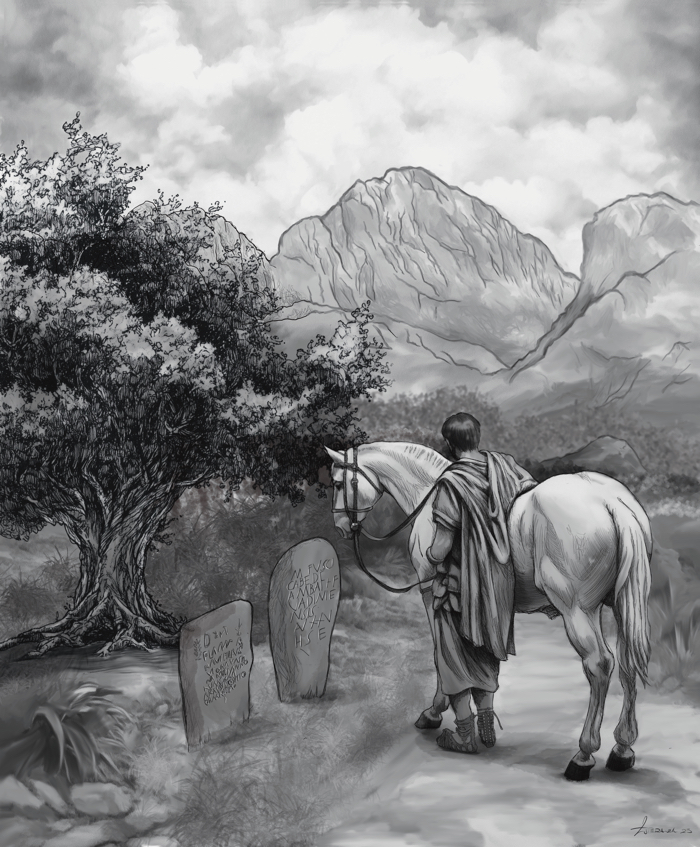
Published in Martino García, David, Epigrafía romana de Cangas de Onís : las estelas vadinienses, Corao, Ayuntamiento de Cangas de Onís, 2025, pp. 251-265. English translation by M.ª Paz Urrea Oñoro. The maps are the work of Fernando Muñoz Villarejo and Esperanza Martín Hernández is the author of the excellent drawing that illustrates a historical scene from Vadinienses.
David Martino García (Madrid, 1972) holds a degree in Geography and History, specializing in Ancient History, from the Complutense University of Madrid. He earned his doctorate from the same university with a dissertation entitled The Roman Cities of the Northern Plateau: Identification, Legal Status, and Oligarchies (1st-3rd Centuries AD). He has participated in various national and international research projects on literary and epigraphic sources, as well as on different aspects of the Ancient History of Spain. His professional career is highlighted by his extensive experience as a Geography and History teacher at the secondary and high school levels, teaching in various schools in Castilla-La Mancha. He has also worked as a tutor at the UNED in Ciudad Real and as a professor of Ancient History at the Complutense University.
 Sociedad Perriniana de Corao